




Skip to Content
Northwoods
Main Content

Hiker looking out over the mountains

9 Minute Read | November 2, 2026

What Is Zero-Click Marketing?

Definition & Best Practices

“Zero-click marketing is the future.” If you’re a digital marketer, there’s a good chance you’ve heard this claim in the past few years. But what is it, and how do you implement it?
Simply put, zero-click marketing means delivering value where your audience already spends its time—such as a Google search results page or an AI chatbot—without requiring a click through to your website. 

Our team often makes a connection to zero click and the “billboard approach”, where cars may pass billboards featuring ads along the highway. We make this connection because zero-click focuses on earning brand awareness and recognition, so when a buyer is ready to act, they remember your company and search for it by name. Because those branded searches come from buyers who already know you, an effective zero-click strategy can increase conversions even when overall traffic doesn’t.

Key Takeaways

  • In the first four months of 2026, 68% of U.S. Google searches ended without a click, according to SparkToro.
  • Brands recommended in ChatGPT were 2.5x more likely to receive a site visit within seven days, according to Similarweb.
  • Zero-click marketing is measured through visibility signals such as search impressions and branded search volume, alongside traditional conversions.

What Is Zero-Click Marketing?

SparkToro co-founder Rand Fishkin popularized the term, defining zero-click marketing as "creating standalone value in the platforms where people hang out, instead of dropping teasers and links in hopes that people will be compelled to click over to your site."

In practice, that means treating every place your brand appears as a full-experience destination. A LinkedIn post should teach the whole idea. A search snippet should answer the question. An AI-generated answer should be able to pull an accurate, specific fact from your content and attribute it to you.

The data driving this shift is increasingly hard to ignore. In the first four months of 2026, SparkToro showed that 68.01% of U.S. Google searches ended without a click, up from 60.45% in 2024. When an AI Overview appears, Ahrefs found that the top-ranking page sees a 58% lower average click-through rate.

Zero-Click Marketing Examples

Zero-click marketing looks different on every platform. Here are some examples for a B2B organization:

  • Search results: A page that defines a technical concept earns a featured snippet or AI Overview mention displaying your brand.
  • AI answers: Informational blog posts with specific, quotable figures get cited by ChatGPT or Gemini when a buyer asks a question.
  • LinkedIn: A 200-word post from a subject matter expert walks through a complete framework and includes a branded graphic with no link.
  • Video: A two-minute clip answers a common customer question, posted natively instead of linking out to a full webinar.
  • Email: A newsletter delivers the full insight in the inbox rather than a teaser with a “read more” button.
  • Earned media: A podcast appearance or industry publication feature puts your brand in front of a new audience, and the mention itself is the value.

Each example trades a potential click for a standalone moment where your audience connects useful content with your brand.

Zero-Click Marketing Best Practices

Here are best practices focused on zero-click marketing tactics and execution. (For the bigger strategic moves, like building your brand as a moat and rethinking attribution, see our post on why zero-click marketing is no longer optional.)

1. Put the answer in the first 100 words.

Search features and AI engines favor content that answers a question quickly. Cyrus Shepard's AI Citation Ranking Factors analysis scored citation factors across more than 50 experiments, patents, and case studies. It rated "Answer Near the Top" an 8.8 out of 10 and rated “Query-Answer Match” a 9.2. 

AI engines apply strict retrieval caps per URL, so an answer buried in the sixth paragraph may never be retrieved.

Open each page with a direct one- or two-sentence answer and do the same at the start of each major section. Then expand with context and proof.

2. Write passages that stand on their own.

AI tools rarely quote a full page. Instead, they pull individual passages. The same analysis scored self-contained passages at 8.0 and factual specificity at 8.3. A sentence like "Standard lead time is six to eight weeks" gives an AI tool something to cite. "We deliver quickly" does not.

Here are a few ways to make passages more citable:

  • Use specific numbers, ranges, and dates wherever you have them.
  • Write summaries and key takeaways as standalone facts.
  • Cite primary sources so AI tools and readers can verify your claims.

3. Keep investing in traditional SEO.

Zero-click marketing doesn't replace SEO. It depends on it. In Shepard's analysis, search rank (9.4) and fan-out rank (9.3) were among the strongest predictors of AI citation, and one study referenced found that 38% of AI Overview citations come from the top 10 Google results.

Fan-out rank refers to how well you rank for the related follow-up searches AI tools run behind the scenes. That's why building out a full topic cluster (scored 8.9) matters more than ranking a single page. For a deeper look at structuring content for AI tools, read our blog How to Optimize Content for AI Search in 2026.

4. Make sure AI tools can read your content.

The highest-scoring factor in Shepard's analysis was URL accessibility (9.5). If a crawler can't reach a page, it can't cite it. Preview control scored 9.2, because snippet directives like nosnippet can remove your content from AI answers.

Take steps to confirm that:

  • Your robots.txt file and firewall or CDN settings aren’t blocking the AI crawlers you want to reach your site.
  • Key content loads in the page HTML.
  • Important pages don’t carry nosnippet or restrictive max-snippet directives.

One thing you can skip: LLMs.txt. It scored 2.0, the lowest of any factor, with no credible evidence that it influences citations.
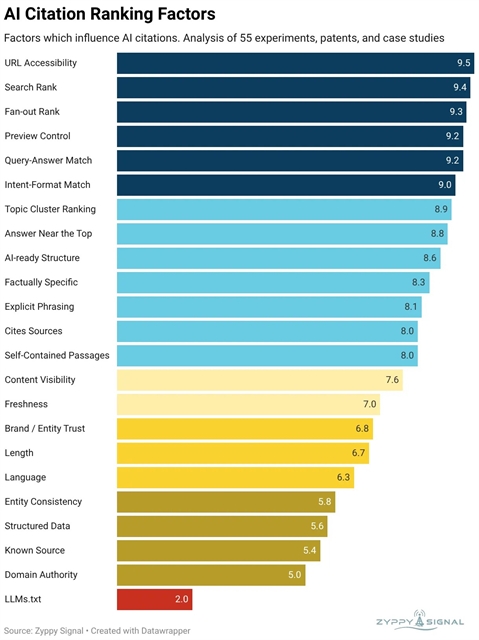
AI Citation Ranking Factors


5. Publish complete ideas natively on social.

Stop adding CTAs to your LinkedIn posts, at least on posts you want to reach users organically. Fishkin reports that zero-click posts earn roughly 10 times the reach of posts with links. 

A roundup of link penalty studies found external links on social media reduce reach by 17% to 36%. That same analysis found the penalty lands mostly on company pages, while personal profiles see almost none.

For B2B teams, social media tactics that can work include:

  • Posting from leadership and employee profiles
  • Summarizing the main points of a blog in the post itself
  • Turning data or processes into carousels or short native video

6. Build your brand into valuable content.

When no one clicks, attribution happens in your audience's memory. Make it easy for them to connect the insight to your brand:

  • Name your frameworks and methodologies so they’re recognizable and repeatable.
  • Put your brand name on every chart, graphic, and video.
  • Publish proprietary data competitors can’t replicate, since original numbers are what AI tools and journalists cite.
  • Describe your company the same way on your website, LinkedIn profile, and directory listings so AI tools recognize one consistent brand.

In Similarweb's research, brands recommended in ChatGPT were 2.5x more likely to receive a site visit within seven days, and 55.9% of those visits came through branded search. The click still happens. It just happens later, and it starts with your name.

7. Turn rented attention into an owned audience.

Social feeds and AI tools are “rented” ground, and their algorithms change without notice. SparkToro recommends converting platform attention into assets you control, like an email list or community.

Zero-click content is how you earn that. A social post that consistently teaches something useful earns follows. A newsletter that delivers the full value in the inbox earns opens. Both keep your brand in front of buyers without depending on any one platform's reach.

8. Measure visibility, not just visits.

If sessions are your only success metric, zero-click marketing will always look like it's underperforming. Pair traditional conversion tracking with signals that show whether your visibility is growing:

  • Search impressions in Google Search Console, which capture visibility even when clicks don’t follow
  • Branded search volume over time
  • How often AI tools mention or cite your brand for your priority topics
  • Self-reported attribution, such as a “How did you hear about us?” field on key forms

A buyer who first found you through an AI answer or a LinkedIn post usually shows up in analytics as direct or branded search traffic. A self-reported attribution field in a form helps fill in that gap.

Click-Based Marketing vs. Zero-Click Marketing

Zero-click marketing doesn't eliminate clicks. It changes where they come from and how you measure success. Here's how the two approaches compare:

  Click-Based Marketing Zero-Click Marketing
Primary Goal Drive traffic to your website Build recognition where buyers already are
Content approach Tease the value and link to the full answer Deliver the full value on the platform
Success metrics Sessions and click-through rate Impressions, branded search, and AI citations
Social posts Link-first and promotional Native and standalone, with no link required
Role of the website The main destination Where buyers complete a task once they're ready
Role of SEO Drives clicks Drives visibility and AI citations


Frequently Asked Questions

Is zero-click marketing the same as SEO?

No. SEO is one part of zero-click marketing. Zero-click also includes AI tools and social platforms, plus owned and earned channels like email and PR. It treats visibility as a goal whether or not a click follows. Strong SEO is still the foundation, since search rank is one of the strongest predictors of AI citation.

What is the difference between zero-click marketing and GEO?

Generative engine optimization (GEO) focuses specifically on getting your content cited in AI-generated answers. It's one piece of zero-click marketing, which applies the same standalone-value approach to social media, email, and other channels.

Does zero-click marketing work for B2B companies?

Yes. B2B buyers often conduct their own research using traditional search, AI tools, and peer networks before they ever talk to a sales rep. Zero-click marketing keeps your brand visible during that process, so you're on the shortlist when the buyer is ready to reach out.

Won't giving away information for free hurt lead generation?

Zero-click content gives away the answer, not the service. A buyer who learns something useful from your brand is more likely to trust you when they need help putting that knowledge into practice. The goal is to be remembered, then chosen.

How do you measure zero-click marketing?

Track directional signals alongside conversions. Branded search volume and self-reported attribution on lead forms are two of the most useful. Watch for trends over time rather than expecting one-to-one attribution.

Get Seen When No One Clicks

Zero-click marketing isn't about giving up on traffic. It's about making sure your brand shows up and gets remembered at every point in the buyer's journey. 

Want to know how visible your brand is today? Request a free zero-click consultation, and we'll assess how you show up in AI tools and key platforms, identify gaps and opportunities, and map out where to focus next.


Authored By

Rachelle Bowar

Rachelle Bowar

Digital Marketing Specialist

Share on Social Media

hand-drawn owl

Get Expert Tips

4493115/Blog/What-Is-Zero-Click-MarketingDefinition & Best Practices9
<ul> </ul> <p>&ldquo;Zero-click marketing is the future.&rdquo; If you&rsquo;re a digital marketer, there&rsquo;s a good chance you&rsquo;ve heard this claim in the past few years. But what is it, and how do you implement it?<br /> Simply put, zero-click marketing means delivering value where your audience already spends its time&mdash;such as a Google search results page or an AI chatbot&mdash;without requiring a click through to your website.&nbsp;</p> <p>Our team often makes a connection to zero click and the &ldquo;billboard approach&rdquo;, where cars may pass billboards featuring ads along the highway. We make this connection because zero-click&nbsp;focuses on earning brand awareness and recognition, so when a buyer is ready to act, they remember your company and search for it by name. Because those branded searches come from buyers who already know you, an effective zero-click strategy can increase conversions even when overall traffic doesn&rsquo;t.</p> <p><span class="h4"><strong>Key Takeaways</strong></span></p> <ul> <li>In the first four months of 2026, 68% of U.S. Google searches ended without a click, according to SparkToro.</li> <li>Brands recommended in ChatGPT were 2.5x more likely to receive a site visit within seven days, according to Similarweb.</li> <li>Zero-click marketing is measured through visibility signals such as search impressions and branded search volume, alongside traditional conversions.</li> </ul> <h2>What Is Zero-Click Marketing?</h2> <p>SparkToro co-founder Rand Fishkin <a href="https://sparktoro.com/blog/why-do-we-need-zero-click-marketing/" linktype="3" rel="noopener noreferrer" target="_blank">popularized the term</a>, defining zero-click marketing as &quot;creating standalone value in the platforms where people hang out, instead of dropping teasers and links in hopes that people will be compelled to click over to your site.&quot;</p> <p>In practice, that means treating every place your brand appears as a full-experience destination. A LinkedIn post should teach the whole idea. A search snippet should answer the question. An AI-generated answer should be able to pull an accurate, specific fact from your content and attribute it to you.</p> <p>The data driving this shift is increasingly hard to ignore. In the first four months of 2026, SparkToro showed that <a href="https://sparktoro.com/blog/in-2026-less-than-one-third-of-google-searches-still-send-a-click/" linktype="3" rel="noopener noreferrer" target="_blank">68.01% of U.S. Google searches ended without a click</a>, up from 60.45% in 2024. When an AI Overview appears, <a href="https://ahrefs.com/blog/ai-overviews-reduce-clicks-update/" linktype="3" rel="noopener noreferrer" target="_blank">Ahrefs found</a> that the top-ranking page sees a 58% lower average click-through rate.</p> <h2>Zero-Click Marketing Examples</h2> <p>Zero-click marketing looks different on every platform. Here are some examples for a B2B organization:</p> <ul> <li><strong>Search results:</strong> A page that defines a technical concept earns a featured snippet or AI Overview mention displaying your brand.</li> <li><strong>AI answers:</strong> Informational blog posts with specific, quotable figures get cited by ChatGPT or Gemini when a buyer asks a question.</li> <li><strong>LinkedIn:</strong> A 200-word post from a subject matter expert walks through a complete framework and includes a branded graphic with no link.</li> <li><strong>Video:</strong> A two-minute clip answers a common customer question, posted natively instead of linking out to a full webinar.</li> <li><strong>Email: </strong>A newsletter delivers the full insight in the inbox rather than a teaser with a &ldquo;read more&rdquo; button.</li> <li><strong>Earned media:</strong> A podcast appearance or industry publication feature puts your brand in front of a new audience, and the mention itself is the value.</li> </ul> <p>Each example trades a potential click for a standalone moment where your audience connects useful content with your brand.</p> <h2>Zero-Click Marketing Best Practices</h2> <p>Here are best practices focused on zero-click marketing tactics and execution. (For the bigger strategic moves, like building your brand as a moat and rethinking attribution, see our post on <a href="/Blog/Why-Zero-Click-Marketing-Is-No-Longer-Optional-and-What-to-Do-About-It" linktype="8" target="_self">why zero-click marketing is no longer optional</a>.)</p> <h3>1. Put the answer in the first 100 words.</h3> <p>Search features and AI engines favor content that answers a question quickly. Cyrus Shepard&#39;s <a href="https://signal.zyppy.com/p/ai-citation-ranking-factors" linktype="3" rel="noopener noreferrer" target="_blank">AI Citation Ranking Factors analysis</a> scored citation factors across more than 50 experiments, patents, and case studies. It rated &quot;Answer Near the Top&quot; an 8.8 out of 10 and rated &ldquo;Query-Answer Match&rdquo; a 9.2.&nbsp;</p> <p>AI engines apply strict retrieval caps per URL, so an answer buried in the sixth paragraph may never be retrieved.</p> <p>Open each page with a direct one- or two-sentence answer and do the same at the start of each major section. Then expand with context and proof.</p> <h3>2. Write passages that stand on their own.</h3> <p>AI tools rarely quote a full page. Instead, they pull individual passages. The same analysis scored self-contained passages at 8.0 and factual specificity at 8.3. A sentence like &quot;Standard lead time is six to eight weeks&quot; gives an AI tool something to cite. &quot;We deliver quickly&quot; does not.</p> <p>Here are a few ways to make passages more citable:</p> <ul> <li>Use specific numbers, ranges, and dates wherever you have them.</li> <li>Write summaries and key takeaways as standalone facts.</li> <li>Cite primary sources so AI tools and readers can verify your claims.</li> </ul> <h3>3. Keep investing in traditional SEO.</h3> <p>Zero-click marketing doesn&#39;t replace SEO. It depends on it. In Shepard&#39;s analysis, search rank (9.4) and fan-out rank (9.3) were among the strongest predictors of AI citation, and one study referenced found that 38% of AI Overview citations come from the top 10 Google results.</p> <p>Fan-out rank refers to how well you rank for the related follow-up searches AI tools run behind the scenes. That&#39;s why building out a full topic cluster (scored 8.9) matters more than ranking a single page. For a deeper look at structuring content for AI tools, read our blog <a href="/Blog/How-to-Optimize-Content-for-AI-Search-in-2026" linktype="8" target="_self">How to Optimize Content for AI Search in 2026</a>.</p> <h3>4. Make sure AI tools can read your content.</h3> <p>The highest-scoring factor in Shepard&#39;s analysis was <a href="/Services/Websites/Web-Accessibility" linktype="2" target="_self">URL accessibility</a> (9.5). If a crawler can&#39;t reach a page, it can&#39;t cite it. Preview control scored 9.2, because snippet directives like nosnippet can remove your content from AI answers.</p> <p>Take steps to confirm that:</p> <ul> <li>Your robots.txt file and firewall or CDN settings aren&rsquo;t blocking the AI crawlers you want to reach your site.</li> <li>Key content loads in the page HTML.</li> <li>Important pages don&rsquo;t carry nosnippet or restrictive max-snippet directives.</li> </ul> <p>One thing you can skip: LLMs.txt. It scored 2.0, the lowest of any factor, with no credible evidence that it influences citations.</p> <p><img alt="AI Citation Ranking Factors" height="640" loading="lazy" src="/Northwoods-2023/Blog/Article-Images/AI-Citation-Ranking-Factors.jpg?Large" width="479" /></p> <p>&nbsp;</p> <h3>5. Publish complete ideas natively on social.</h3> <p>Stop adding CTAs to your LinkedIn posts, at least on posts you want to reach users organically. Fishkin reports that zero-click posts earn <a href="https://sparktoro.com/blog/why-do-we-need-zero-click-marketing/" linktype="3" rel="noopener noreferrer" target="_blank">roughly 10 times the reach</a> of posts with links.&nbsp;</p> <p>A r<a href="https://www.tryordinal.com/blog/linkedin-link-penalty-study" linktype="3" rel="noopener noreferrer" target="_blank">oundup of link penalty studies</a> found external links on social media reduce reach by 17% to 36%. That same analysis found the penalty lands mostly on company pages, while personal profiles see almost none.</p> <p>For B2B teams, social media tactics that can work include:</p> <ul> <li>Posting from leadership and employee profiles</li> <li>Summarizing the main points of a blog in the post itself</li> <li>Turning data or processes into carousels or short native video</li> </ul> <h3>6. Build your brand into valuable content.</h3> <p>When no one clicks, attribution happens in your audience&#39;s memory. Make it easy for them to connect the insight to your brand:</p> <ul> <li>Name your frameworks and methodologies so they&rsquo;re recognizable and repeatable.</li> <li>Put your brand name on every chart, graphic, and video.</li> <li>Publish proprietary data competitors can&rsquo;t replicate, since original numbers are what AI tools and journalists cite.</li> <li>Describe your company the same way on your website, LinkedIn profile, and directory listings so AI tools recognize one consistent brand.</li> </ul> <p>In <a href="https://www.similarweb.com/corp/reports/the-downstream-impact-of-ai-visibilty/" linktype="3" rel="noopener noreferrer" target="_blank">Similarweb&#39;s research</a>, brands recommended in ChatGPT were 2.5x more likely to receive a site visit within seven days, and <a href="https://www.searchenginejournal.com/ai-recommended-brands-saw-2-5x-more-site-visits-similarweb/580241/" linktype="3" rel="noopener noreferrer" target="_blank">55.9% of those visits came through branded search</a>. The click still happens. It just happens later, and it starts with your name.</p> <h3>7. Turn rented attention into an owned audience.</h3> <p>Social feeds and AI tools are &ldquo;rented&rdquo; ground, and their algorithms change without notice. <a href="https://sparktoro.com/blog/zero-click-search-what-still-works/" linktype="3" rel="noopener noreferrer" target="_blank">SparkToro recommends</a> converting platform attention into assets you control, like an email list or community.</p> <p>Zero-click content is how you earn that. A social post that consistently teaches something useful earns follows. A newsletter that delivers the full value in the inbox earns opens. Both keep your brand in front of buyers without depending on any one platform&#39;s reach.</p> <h3>8. Measure visibility, not just visits.</h3> <p>If sessions are your only success metric, zero-click marketing will always look like it&#39;s underperforming. Pair traditional conversion tracking with signals that show whether your visibility is growing:</p> <ul> <li>Search impressions in Google Search Console, which capture visibility even when clicks don&rsquo;t follow</li> <li>Branded search volume over time</li> <li>How often AI tools mention or cite your brand for your priority topics</li> <li>Self-reported attribution, such as a &ldquo;How did you hear about us?&rdquo; field on key forms</li> </ul> <p>A buyer who first found you through an AI answer or a LinkedIn post usually shows up in analytics as direct or branded search traffic. A self-reported attribution field in a form helps fill in that gap.</p> <h2>Click-Based Marketing vs. Zero-Click Marketing</h2> <p>Zero-click marketing doesn&#39;t eliminate clicks. It changes where they come from and how you measure success. Here&#39;s how the two approaches compare:</p> <table border="1" cellpadding="0" cellspacing="2" style="width:741px"> <thead> <tr> <th scope="col" style="width: 155px;">&nbsp;</th> <th scope="col" style="width: 252px;">Click-Based Marketing</th> <th scope="col" style="width: 319px;">Zero-Click Marketing</th> </tr> </thead> <tbody> <tr> <td style="width:155px"><strong>Primary Goal</strong></td> <td style="width:252px"><span style="font-size:12pt"><span style="font-family:Aptos,sans-serif">Drive traffic to your website</span></span></td> <td style="width:319px"><span style="font-size:12pt"><span style="font-family:Aptos,sans-serif">Build recognition where buyers already are</span></span></td> </tr> <tr> <td style="width:155px"><strong>Content approach</strong></td> <td style="width:252px"><span style="font-size:12pt"><span style="font-family:Aptos,sans-serif">Tease the value and link to the full answer</span></span></td> <td style="width:319px"><span style="font-size:12pt"><span style="font-family:Aptos,sans-serif">Deliver the full value on the platform</span></span></td> </tr> <tr> <td style="width:155px"><strong>Success metrics</strong></td> <td style="width:252px"><span style="font-size:12pt"><span style="font-family:Aptos,sans-serif">Sessions and click-through rate</span></span></td> <td style="width:319px"><span style="font-size:12pt"><span style="font-family:Aptos,sans-serif">Impressions, branded search, and AI citations</span></span></td> </tr> <tr> <td style="width:155px"><strong>Social posts</strong></td> <td style="width:252px"><span style="font-size:12pt"><span style="font-family:Aptos,sans-serif">Link-first and promotional</span></span></td> <td style="width:319px"><span style="font-size:12pt"><span style="font-family:Aptos,sans-serif">Native and standalone, with no link required</span></span></td> </tr> <tr> <td style="width:155px"><strong>Role of the website</strong></td> <td style="width:252px"><span style="font-size:12pt"><span style="font-family:Aptos,sans-serif">The main destination</span></span></td> <td style="width:319px"><span style="font-size:12pt"><span style="font-family:Aptos,sans-serif">Where buyers complete a task once they&#39;re ready</span></span></td> </tr> <tr> <td style="width:155px"><strong>Role of SEO</strong></td> <td style="width:252px"><span style="font-size:12pt"><span style="font-family:Aptos,sans-serif">Drives clicks</span></span></td> <td style="width:319px"><span style="font-size:12pt"><span style="font-family:Aptos,sans-serif">Drives visibility and AI citations</span></span></td> </tr> </tbody> </table> <p>&nbsp;</p> <h2>Frequently Asked Questions</h2> <h3>Is zero-click marketing the same as SEO?</h3> <p>No. SEO is one part of zero-click marketing. Zero-click also includes AI tools and social platforms, plus owned and earned channels like email and PR. It treats visibility as a goal whether or not a click follows. Strong SEO is still the foundation, since search rank is one of the strongest predictors of AI citation.</p> <h3>What is the difference between zero-click marketing and GEO?</h3> <p>Generative engine optimization (GEO) focuses specifically on getting your content cited in AI-generated answers. It&#39;s one piece of zero-click marketing, which applies the same standalone-value approach to social media, email, and other channels.</p> <h3>Does zero-click marketing work for B2B companies?</h3> <p>Yes. B2B buyers often conduct their own research using traditional search, AI tools, and peer networks before they ever talk to a sales rep. Zero-click marketing keeps your brand visible during that process, so you&#39;re on the shortlist when the buyer is ready to reach out.</p> <h3>Won&#39;t giving away information for free hurt lead generation?</h3> <p>Zero-click content gives away the answer, not the service. A buyer who learns something useful from your brand is more likely to trust you when they need help putting that knowledge into practice. The goal is to be remembered, then chosen.</p> <h3>How do you measure zero-click marketing?</h3> <p>Track directional signals alongside conversions. Branded search volume and self-reported attribution on lead forms are two of the most useful. Watch for trends over time rather than expecting one-to-one attribution.</p> <h2>Get Seen When No One Clicks</h2> <p>Zero-click marketing isn&#39;t about giving up on traffic. It&#39;s about making sure your brand shows up and gets remembered at every point in the buyer&#39;s journey.&nbsp;</p> <p><em>Want to know how visible your brand is today? Request a free <a href="/Zero-Click-Marketing" linktype="2" target="_self">zero-click consultation</a>, and we&#39;ll assess how you show up in AI tools and key platforms, identify gaps and opportunities, and map out where to focus next.</em></p>
/Northwoods-2020/Hero-Images/Hiker-Looking-Out-Over-Mountains.pngHiker looking out over the mountainsAlex Boston/Northwoods-2020/People/Rachelle-Bowar.jpgRachelle Bowar in front of a log cabin wall.<script charset="utf-8" type="text/javascript" src="//js.hsforms.net/forms/embed/v2.js"></script><script>hbspt.forms.create({ region: "na1", portalId: "23630176", formId: "40c5bbae-05a2-42ea-94dd-1662181fd56e" });</script>/Northwoods-2023/Blog/Social-Cards/What-Is-Zero-Click-Marketing_-Definition--Best-Practices.jpgWhat Is Zero-Click Marketing?2026-11-02T00:00:00/Northwoods-2023/Blog/Social-Cards/What-Is-Zero-Click-Marketing_-Definition--Best-Practices.jpgWhat is zero-click marketing? Learn what it means, see B2B examples, and get eight best practices for earning visibility when no one clicks.428058/People/Rachelle-BowarRachelleBowarDigital Marketing Specialist<p>Rachelle is a skilled digital marketer with expertise in SEO, social media, paid ads, Google Analytics, and WordPress, and extensive experience working with B2B clients. Certified as a Digital Marketing Professional (CDMP) and a Professional Certified Marketer (PCM), she&rsquo;s passionate about data and digital strategy and is excited to hone her skills as the digital landscape continuously evolves. Outside of work, Rachelle enjoys fitness, cooking, and playing chess with her daughter. Her Shetland Sheepdog, Cookie, is known to tag along to the office and is among our newest canine coworkers.</p>Rachelle BowarRachelle is a skilled digital marketer with expertise in SEO, social media, paid ads, Google Analytics, and WordPress, and extensive experience working with B2B clients./Northwoods-2020/People/Rachelle-Bowar.jpgRachelle BowarAdd-In Type - NWS Data ModulesAudience - NWS Data ModulesCategory - NWS Data ModulesCommittee - NWS Data ModulesDivision - NWS Data ModulesEvent Audience - NWS Data ModulesEvent Service - NWS Data ModulesEvent Type - NWS Data ModulesFile Type - NWS Data ModulesLocality - NWS Data ModulesModule - NWS Data ModulesPackage Type - NWS Data ModulesPerson - NWS Data ModulesPersonID - NWS Data ModulesRachelle BowarPractice Area - NWS Data ModulesProduct Version - NWS Data ModulesProductVersion - NWS Data ModulesRecord Maturity - NWS Data ModulesRecorded Webinar TopicsRegion - NWS Data ModulesResource Type - NWS Data ModulesSite Display - NWS Data ModulesSkillLevel - NWS Data ModulesTopic - NWS Data ModulesVideo Status - NWS Data ModulesVideoAudience - NWS Data ModulesVideoClassification - NWS Data ModulesVideoStatus - NWS Data ModulesTeamAll StaffStrategistsAdd-In Type - NWS Data ModulesAudience - NWS Data ModulesCategory - NWS Data ModulesCommittee - NWS Data ModulesDivision - NWS Data ModulesEvent Audience - NWS Data ModulesEvent Service - NWS Data ModulesEvent Type - NWS Data ModulesFile Type - NWS Data ModulesLocality - NWS Data ModulesModule - NWS Data ModulesPackage Type - NWS Data ModulesPerson - NWS Data ModulesPersonID - NWS Data ModulesRachelle BowarPractice Area - NWS Data ModulesProduct Version - NWS Data ModulesProductVersion - NWS Data ModulesRecord Maturity - NWS Data ModulesRecorded Webinar TopicsRegion - NWS Data ModulesResource Type - NWS Data ModulesSite Display - NWS Data ModulesNWS DigitalSkillLevel - NWS Data ModulesTopic - NWS Data ModulesArtificial Intelligence (AI)Digital MarketingSEO & Content MarketingVideo Status - NWS Data ModulesVideoAudience - NWS Data ModulesVideoClassification - NWS Data ModulesVideoStatus - NWS Data Modules02026-11-02T08:34:36.97300