



Users are now seeing Google Ads within AI Mode and AI Overviews more and more often. Google's expansion of ad placements inside AI Mode signals a fundamental change in how paid search shows up in AI-powered search experiences.
For advertisers, this is new real estate to consider when creating dynamic ad campaigns.
Key Takeaways
- Google Ads are increasingly surfacing directly inside AI Mode answers, not just above or below them.
- Eligibility depends on campaign types and AI-powered targeting.
- Ads must align with both the user’s query and the AI-generated answer, which raises the bar for relevancy and landing page quality.
- Advertisers should update measurement, creative, and search strategies now, to stay ahead as AI search and paid ads converge.
What Is Google's AI Mode in Search?
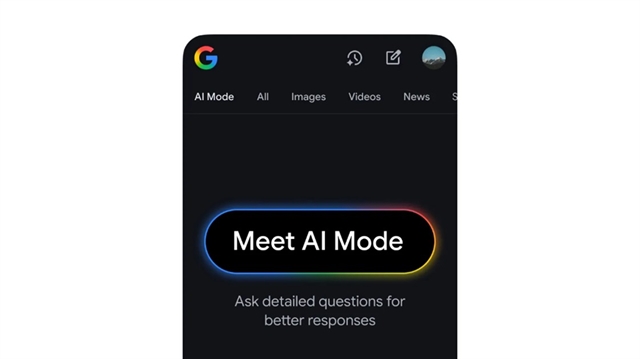
Google’s AI Mode is a self-contained search experience that uses Gemini, Google’s AI assistant, to deliver conversational, multi-step answers instead of a single list of links.
Unlike a traditional SERP, AI Mode is designed for follow-up questions and deeper research journeys, in which users refine their queries over several turns. AI Mode is more like an AI assistant within Google Search; it weaves ads, links, and supporting content into an ongoing conversation with the user. The user experience substantially differs from that of a list of links and blurbs.
AI Mode is different from AI Overviews, in which a single, AI-generated box appears within a standard results page. In AI Overviews, ads can show above or below the AI answer.
In AI Mode, the browser becomes a dedicated environment to a search query. The entire experience can include contextual ad placements.
How Are Google Ads Surfacing Inside AI Mode?
Google first began testing Search and Shopping ads inside AI Mode in the U.S. in mid-2025. The company has steadily expanded these placements to more users and devices. Reports indicate that more and more ads are embedded directly within AI answers.
AI Mode is moving from a limited experiment to a potential new ad surface within Search. Marketers must account for this shift when they design their campaigns.
Note: Ads in AI Mode are not a separate campaign type; they are additional placements for existing Google Search (using broad match/dynamic ads), Shopping, and Performance Max for campaigns.
Google applies its existing auction and ranking systems to AI, but it adds layers of contextual signals from the full AI conversation to decide when, where, and how ads should appear.
Google Ads in AI Mode vs. AI Overviews
While AI Mode and AI Overviews are related, each creates a slightly different opportunity for Google Ads.
| Aspect | AI Overviews + Google Ads | AI Mode + Google Ads |
| Experience type | AI box embedded in a traditional SERP, alongside organic results and standard ad units. | Dedicated conversational search interface focused on multi-step queries and follow-ups. |
| Where ads appear | Ads can show above or below the AI Overview, and in some cases within the AI-generated content. | Search and Shopping ads appear inside AI answers and across the conversation as the user refines queries. |
| Trigger conditions | AI Overviews appears for complex and informational queries; ads show when commercial inent and relevant inventory exist. | AI Mode is explicitly designed for deeper, multi-turn exploration. Ads are targeted using full-conversation context, not just a single query. |
| Reporting & control | Ads are treated as Top Ads and reported within existing Google Ads reporting; advertisers cannot target AI Overviews as a separate placement. | Similar approach: advertisers cannot isolate AI Mode placement, and performance is aggregated with eligible Search, Shopping, and Performance Max campaigns. |
For marketers, the practical takeaway is that Google Ads in AI Mode and Google Ads in AI Overviews share underlying mechanics but play slightly different roles in the user journey.
AI Overviews lean into high-level research moments on a traditional SERP, while AI Mode supports extended, conversational discovery, in which ads can follow the thread of the conversation.
How Google Determines Which Ads Show
Google has clarified that ads around and within AI Overviews use existing Google Ads auction and ranking systems, but they only show when certain conditions are met. The systems look for complex, no-one-right-answer queries, then check for commercial intent and for the availability of high-quality, relevant ads.
Similar logic applies in AI Mode, with an additional emphasis on matching ads not only to the query, but also to the AI-generated answer and the overall context of the conversation.
Both AI Mode and AI Overviews raise the bar for relevance and landing page quality above that of traditional keyword matching alone. Advertisers whose ad copy and landing experiences closely align with the informational intent gleaned from AI responses, rather than strict adherence to keywords, are more likely to earn impressions in AI Mode and AI Overviews.
Eligibility: Campaign Types and Settings Matter
Today, ads in AI Overviews and AI Mode draw from several existing campaign types and require specific AI-powered targeting settings. Google has indicated that the following are typically eligible for these placements:
- Search campaigns using broad match and smart bidding, including AI Max for Search.
- Shopping campaigns with product feeds aligned to the query and to AI content.
- Performance Max campaigns, which can surface Search and Shopping-style units across AI experiences.
- App campaigns in certain AI Overview contexts, where app objectives align with the query and answer.
Google hasn’t made it possible to explicitly target or exclude AI Overviews or AI Mode as standalone placements.
Instead, advertisers must accept that participation in broad, AI-driven placements is part of opting into these campaign types and smart targeting features, including such keywordless approaches as Dynamic Search Ads and Performance Max.
Why Google Ads in AI Mode Matter for Advertisers
The expansion of Google Ads in AI Mode changes both visibility and user behavior in the search journey.
As user attention shifts into AI-generated and conversational answers, traditional top-of-page ads and blue links will share more screen real estate with AI content. This could affect click-through patterns and how users evaluate options.
Early reports suggest that AI-driven user experiences may reduce some types of clicks but increase engagement with rich, contextually aligned ads that surface in AI answers. This creates a dual challenge: Advertisers must defend performance in a more crowded, AI-heavy SERP while learning to capitalize on new, in-answer placements that may have strong mid-funnel intent.
How to Prepare Your Google Ads for AI Mode
Advertisers can take several practical steps now to position their Google Ads strategies for AI Mode and other AI surfaces.
1) Lean Into AI-Powered Campaign Types (with Guardrails)
Ensure that at least some campaigns use broad match with smart bidding, Performance Max, or AI Max for Search so you are eligible for AI Mode and AI Overview placements. Use clear conversion tracking and value-based bidding to give Google’s algorithms strong signals about which queries and contexts drive meaningful outcomes.
2) Optimize Landing Pages for Depth and Alignment
AI Mode and AI Overviews favor content that addresses complex questions with clear, comprehensive answers drawn from multiple perspectives. Build landing pages that satisfy the query’s informational needs alongside calls to action, rather than thin, single-focus sales pages.
3) Match Creative to Conversational Intent
Shift some ad copy away from pure direct response and toward messaging that fits research-oriented, mid-funnel queries, especially in B2B. Position your offers as helpful next steps – guides, consultations, assessments, demos – in the research process.
4) Update Measurement and Reporting Expectations
Because AI Mode and AI Overviews aren’t separable placements, performance will show up within existing campaign metrics. Watch for changes in impression share, CTR, and conversion contribution from eligible campaigns. Consider segmenting by search terms and query themes to infer where AI-driven traffic is growing. AI ads show up under the broad “Search” channel within Performance Max’s Channel Performance. They aren’t yet differentiated.
Turning AI Mode into an Advantage for Your Google Ads
As AI-generated answers occupy more space and guide more of the user journey, brands that adapt early will be better positioned to capture demand and stay visible as behavior shifts.
Is your team rethinking how Google Ads, SEO, and content strategy fit together in an AI-first search world? This is the moment to update your playbook. Consider how your PPC stack can support AI-shaped search journeys, then prioritize testing and measurement into one unified approach.
Need a partner to help navigate this shifting environment? This is exactly the type of challenge a digital marketing and advertising team like ours loves to solve. Contact us today to learn more.